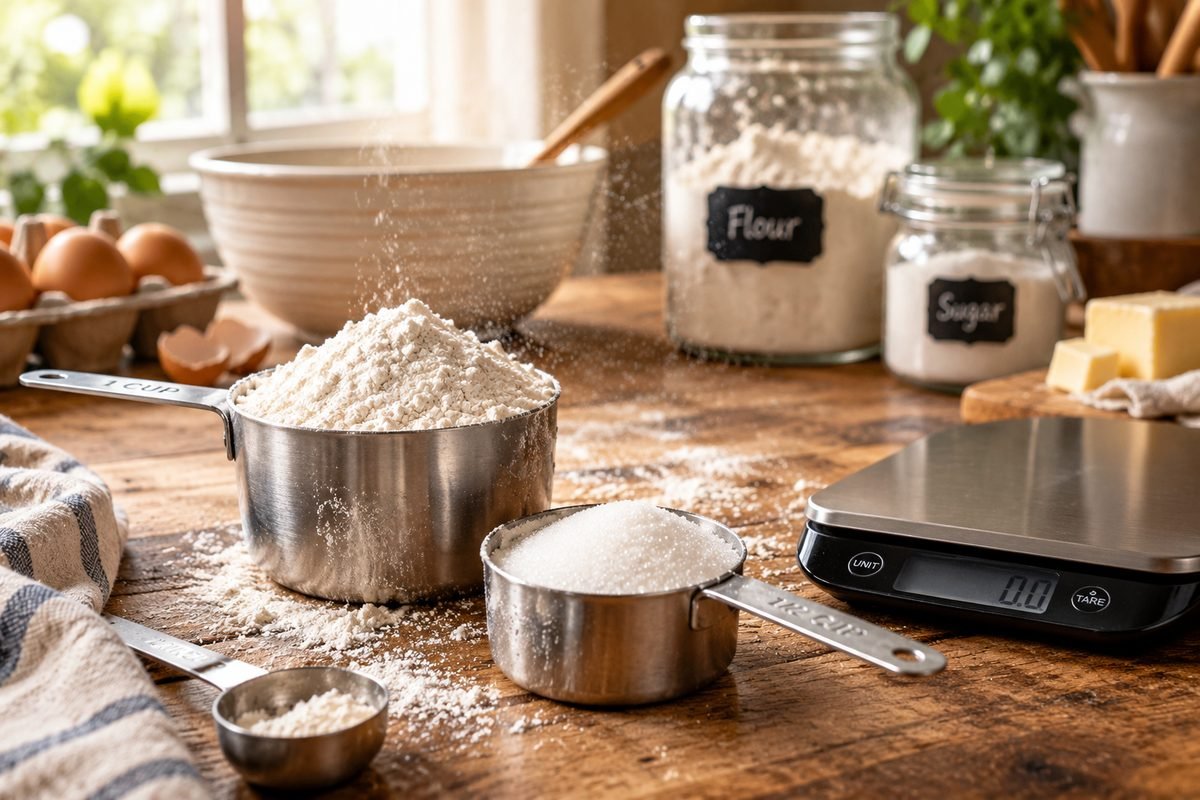
She followed the recipe exactly. Two cups of flour, one cup of sugar, half a cup of cocoa — measured carefully, levelled with a knife, baked at the exact temperature. And yet the cake came out dry, dense, and faintly sad. If this has happened to you, you are not a bad baker. You are probably a victim of the most common measurement mistake in home baking: trusting cups as if they were grams.
This post explains why that mistake happens, shows you exactly where it hurts the most, and gives you three ways to fix it today — including a free converter that does the maths for 22 ingredients in seconds.
Cups measure space. Grams measure weight.
A cup tells you how much room an ingredient takes up. A gram tells you how heavy it is. Those are two completely different things, and the bridge between them — density — changes with every ingredient you touch.
One US cup of honey weighs 340 grams. One US cup of rolled oats weighs 90 grams. Same cup, nearly four times the weight. When a recipe says “1 cup”, it is really saying “however many grams of this particular ingredient happen to fill this much space” — and unless you know that number, you are guessing.
The flour trap: where most cakes die
Flour is the biggest offender because it is both the most common baking ingredient and the most variable. A level US cup of all-purpose flour, spooned in loosely and levelled, weighs about 120 grams. But scoop that same cup straight from the bag — the way most of us actually do it — and you can pack in 150 grams or more. That is a 25% overdose of flour in every cup, and nobody told your cake.
Too much flour is the classic cause of dry, tough cakes and dense bread. Too little structure, and things collapse. When the difference between success and failure is a spoonful, “about two cups” is not a measurement — it is a wish.
Five ingredients where cups lie to you most
Some ingredients are forgiving. Chopped vegetables in a soup will not ruin dinner if you are 20 grams off. But these five punish guesswork:
- Flour (120 g per cup): compacts unpredictably; the number-one cake killer.
- Cocoa powder (85 g per cup): extremely light and airy — a “heaped” cup can double the intended amount and turn chocolate cake bitter.
- Powdered sugar (120 g per cup): clumps and settles; sifted versus packed differs enormously.
- Brown sugar (220 g per packed cup): recipes assume it is firmly packed — a loosely filled cup can be 30–40 grams short, throwing off moisture and caramel flavour.
- Butter (227 g per cup): less variable, but converting sticks to cups to grams by eye is where pastry goes wrong.
The second trap: not all cups are equal
Even if you measure perfectly, which cup you own matters. A US cup holds 236.6 ml. A metric cup — standard in Australia, New Zealand and Canada — holds 250 ml. Follow an American recipe with a metric cup and every single measurement is silently 6% too large. Older British recipes may even mean the 284 ml imperial cup. For an authoritative reference, see King Arthur Baking’s ingredient weight chart, which lists volume-to-weight equivalents for hundreds of ingredients. Six percent does not sound like much until it applies to the flour, the sugar, the butter and the leavening all at once.
Three ways to fix it today
1. Convert, don’t guess. The fastest fix is our free cups-to-grams converter: pick your ingredient, pick your cup size (US, metric or imperial), enter the amount, and get grams instantly — plus ounces and kitchen-friendly measures like “2 cups + 3 tbsp” for the reverse direction. It covers 22 ingredients with real measured densities, not one-size-fits-all estimates.
2. Learn the five numbers that matter. You do not need to memorise 22 densities. Memorise these five and you will survive 90% of baking: flour 120, sugar 200, butter 227, honey 340, oats 90 (grams per US cup). Everything else, look up.
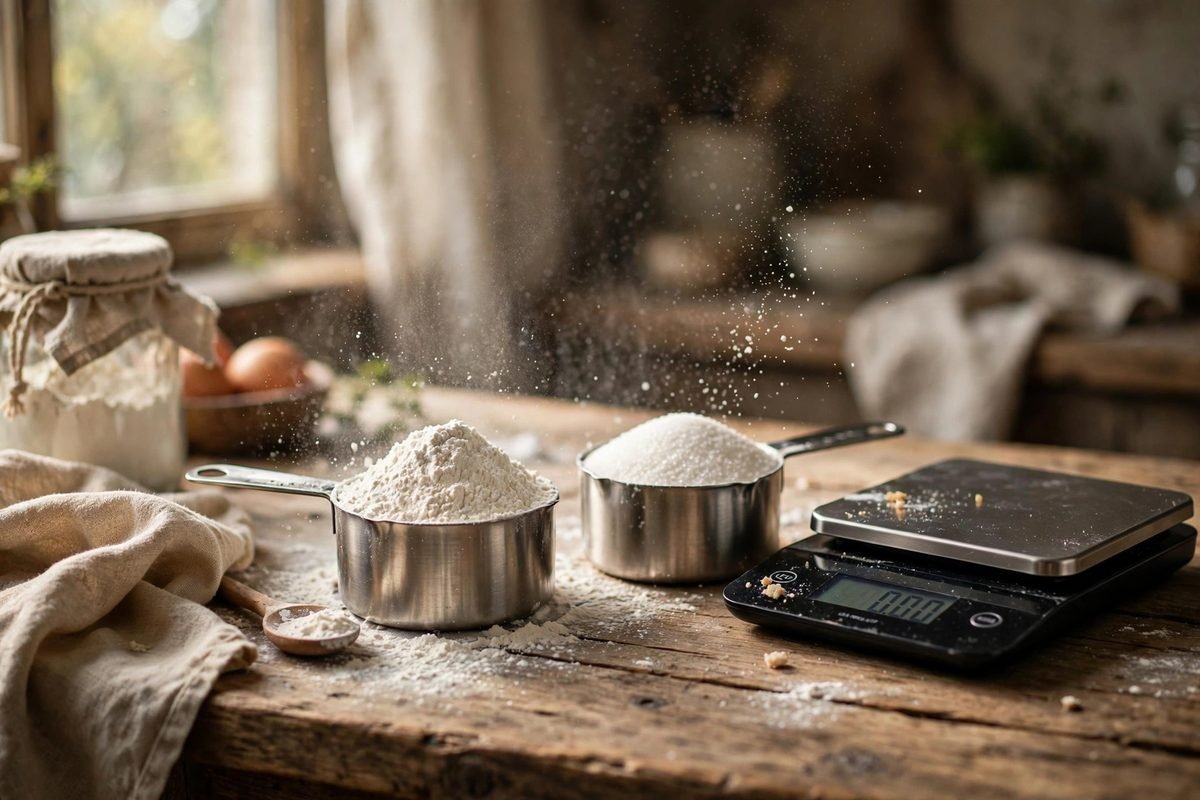
3. Buy a kitchen scale. A digital scale costs about the same as two takeaway coffees and eliminates the problem permanently. Professional bakers do not own measuring cups for flour — there is a reason. Until then, the converter is the next best thing.
A quick rule of thumb for reading recipes
When a recipe gives you both cups and grams, always trust the grams — the author weighed it, and the cups are the approximate translation, not the other way round. When a recipe gives only cups, convert the flour and sugar before you start, not as you go; converting mid-bake is how errors stack up. And when doubling a recipe, convert first and then multiply the grams — multiplying cups first and converting after multiplies your measuring error too.
Your 60-second conversion cheat sheet
Stick this on the fridge until the numbers become instinct. All values are per level US cup:
| Ingredient | 1 cup | ½ cup | ¼ cup |
|---|---|---|---|
| All-purpose flour | 120 g | 60 g | 30 g |
| Granulated sugar | 200 g | 100 g | 50 g |
| Brown sugar (packed) | 220 g | 110 g | 55 g |
| Butter | 227 g | 114 g | 57 g |
| Honey | 340 g | 170 g | 85 g |
| Rolled oats | 90 g | 45 g | 23 g |
| Cocoa powder | 85 g | 43 g | 21 g |
| Milk / water | 240 g | 120 g | 60 g |
Need a different ingredient or cup size? The full converter covers 22 ingredients and three cup standards.
Why weighing wins: the consistency argument
Here is the deeper reason professionals never look back after switching to grams: repeatability. A cup of flour measured on a humid day in July weighs more than the same cup measured in dry January, because flour absorbs moisture from the air. Your technique drifts too — some days you scoop aggressively, some days you spoon delicately. Grams do not drift. Two hundred grams of sugar is two hundred grams of sugar in any kitchen, in any season, in any country.
That consistency compounds. When you bake the same cake three times from gram measurements, you get the same cake three times — and only then can you actually improve the recipe, because you know the recipe is the variable, not your measuring. Cups keep you re-running the same experiment with different inputs and wondering why the result keeps changing.
Frequently asked questions
Can I just use cups instead of a scale for baking?
You can for forgiving recipes like pancakes or muffins, but for cakes, bread and pastry a scale is strongly recommended. A cup of flour can vary by 25% depending on how you fill it, which is enough to ruin texture.
Why did my cake turn out dry even though I followed the recipe?
The most common cause is too much flour from scooping the measuring cup directly into the bag, which packs it down. Spoon flour loosely into the cup and level it off — or better, weigh 120 grams per cup.
How many grams is a cup of flour?
About 120 grams for a level US cup of all-purpose flour, measured spooned-and-levelled. Use our cups-to-grams converter for other ingredients and cup sizes.
Should I sift flour before or after measuring?
After, unless the recipe says “1 cup sifted flour”. Sifting adds air, so a cup of sifted flour weighs roughly 100 grams versus 120 grams unsifted.
Are American and Australian cups the same?
No. A US cup is 236.6 ml; an Australian metric cup is 250 ml — about 6% larger. Using the wrong cup scales every measurement in the recipe.
What is a good cheap kitchen scale?
Any digital scale with 1-gram resolution and a tare (zero) button is enough for home baking; they typically cost less than two takeaway coffees. Look for one with a pull-out display so large bowls do not hide the readout.
The bottom line
Your cake did not fail because you are a bad baker. It failed because a cup is a container, not a quantity — and recipes written in cups are asking you to do density physics in your head. Stop doing it in your head. Convert cups to grams properly, weigh what matters, and the recipe will finally do what it promised.
1 thought on “Why Your Cake Failed: The Cups-vs-Grams Mistake (and the 5-Minute Fix)”
Comments are closed.