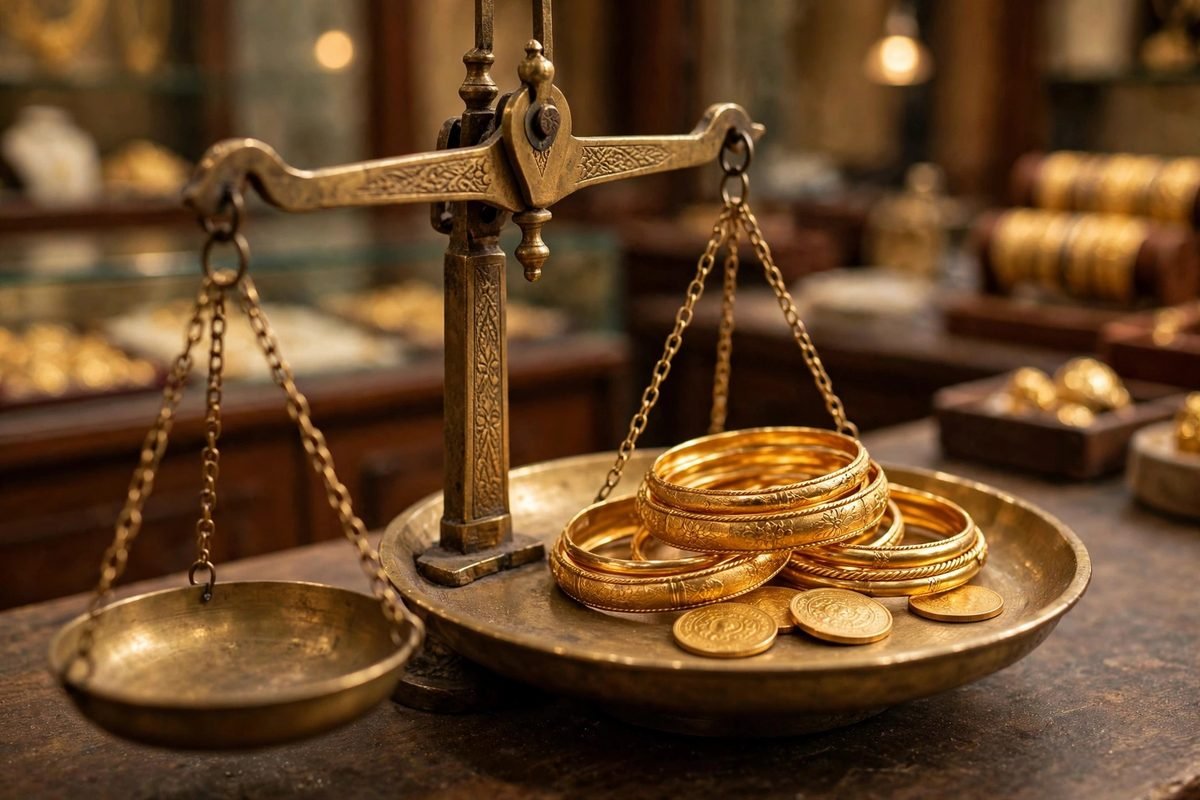
If you own at least 7.5 tola (87.48 grams) of gold and you’ve held it for one full lunar year, you owe 2.5% of its current market value as zakat. That’s the whole rule. Everything else — the annual family argument about worn jewellery, the karat confusion, the “gold nisab or silver nisab?” debate — is detail. Important detail. But detail.
Every Ramadan the same WhatsApp forwards circulate, and half of them are wrong. So let’s do the maths properly, once, with real numbers.
The 30-second version
- Nisab: 7.5 tola (87.48 g) of gold. Below that, no zakat on gold alone.
- Rate: 2.5% of the gold’s value today — not what you paid for it.
- Worn jewellery: in the Hanafi school, which most Pakistanis follow, it counts. All of it.
- Mixed wealth: if you also hold cash or savings, the lower silver nisab (52.5 tola) usually applies instead.
- Yearly: zakat on gold recurs every lunar year you stay above nisab.
The formula (it’s genuinely simple)
Zakat = (total weight of your gold × today’s price) × 2.5%
Here’s a real one. Say you own 10 tola of 22-karat jewellery — the usual kind in Pakistan. An illustrative 24K rate this week is about Rs 432,700 per tola; check the live 24K gold rate before you calculate, because gold moves daily. Now, 22K is 91.67% pure, so a tola of your jewellery is worth about Rs 396,700.
10 tola × Rs 396,700 = Rs 3,967,000. That’s above the gold nisab (7.5 × Rs 432,700 ≈ Rs 3.25 million). So: Rs 3,967,000 × 2.5% = Rs 99,175. Done. That’s your zakat.
If mental maths isn’t your thing, our free zakat calculator does this in seconds with today’s nisab — gold and silver, tola or grams, debts subtracted.
What counts as “your gold”
Count all of it: the bangles you wear daily, the set in the bank locker, gold coins, bars, TT bars, the gold you received as mahr, even broken pieces waiting to be remade. Worn or stored doesn’t change the Hanafi ruling — if it’s gold and you own it, it’s in.
One thing that trips people up: weigh the gold, not the jewellery. If your necklace weighs 4 tola but a tola of that is diamonds and stones, only 3 tola is zakatable. Ask your jeweller for the gold-only weight. They’ll know exactly what you mean — this question comes up in every sarafa shop, every single Ramadan.
The question every family argues about: worn jewellery
This is the single most debated point in the fiqh of zakat, and both sides have serious scholarship behind them.
The Hanafi position — followed by most Pakistanis: zakat is due on all gold, including jewellery a woman wears every day. The evidence includes the hadith of the woman whose daughter wore two heavy gold bangles and was asked, “Do you pay zakat on them?” (Abu Dawud). Personal use doesn’t change what gold is.
The majority position — Maliki, Shafi’i, Hanbali: jewellery worn regularly in customary amounts is like clothing. Personal-use items, not zakatable wealth. Stored gold and investment gold still count.
My take? If you’re Hanafi, the ruling is clear: pay on all of it. If you follow another school, the exemption is legitimate — though several scholars note that paying anyway is the safer option when you can afford it, because the poor’s right is at stake. Either way, pick a position and stay consistent. Switching schools every year to minimise the bill isn’t how this works. For a full school-by-school breakdown, Musaffa’s guide to zakat on gold and worn jewellery lays out both sides fairly.
22K vs 24K: your bangles aren’t pure gold
This is where real money gets lost. Pakistani bridal and daily-wear jewellery is usually 22 karat — 91.67% gold, the rest alloy. Some pieces are 21K or 18K. The 24K rate you hear on the news is for pure gold bars, not your bangles.
So calculate at the rate that matches your gold’s purity. At a 24K rate of Rs 432,700 per tola:
- 22K jewellery: ≈ Rs 396,700 per tola
- 21K jewellery: ≈ Rs 378,600 per tola
- 18K jewellery: ≈ Rs 324,500 per tola
Using the 24K rate on 22K jewellery overstates your zakat by about 9%. On Rs 4 million of gold, that’s roughly Rs 9,000 extra. Not the end of the world — but why overpay?
Gold nisab or silver nisab?
The gold nisab (7.5 tola) applies when gold is your only zakatable asset. But most people also hold cash, savings, or prize bonds. In that case, most Hanafi scholars say: add everything up and check it against the silver nisab — 52.5 tola of silver — because it’s lower, so more people qualify to give.
The two thresholds are worlds apart:
| Nisab | Weight | Approx. PKR value (Oct 2026) |
|---|---|---|
| Gold nisab | 7.5 tola (87.48 g) | ≈ Rs 3.25 million |
| Silver nisab | 52.5 tola (612.36 g) | ≈ Rs 330,000 |
So a woman with 5 tola of jewellery and Rs 500,000 in savings owes zakat — even though her gold alone sits below 7.5 tola. This is the single most common reason people underpay: they check the gold nisab, see they’re under it, and stop. Meanwhile their savings push them well past the silver one.
Confused by the units themselves? Our tola–masha–ratti explainer covers exactly how jewellers weigh and quote gold.
Three real worked examples
All using the illustrative rate of Rs 432,700 per tola (24K). Your numbers will differ — gold moves daily.
| Situation | Total zakatable value | Nisab check | Zakat (2.5%) |
|---|---|---|---|
| 10 tola of 22K jewellery, no cash | 10 × 396,700 = Rs 3,967,000 | Above gold nisab (Rs 3.25m) | Rs 99,175 |
| 5 tola of 22K jewellery + Rs 500,000 savings | 1,983,500 + 500,000 = Rs 2,483,500 | Below gold nisab, above silver nisab (Rs 330k) | Rs 62,088 |
| 4 tola of 22K jewellery, nothing else | 4 × 396,700 = Rs 1,586,800 | Below gold nisab — no zakat due | Rs 0 |
Look at the middle row — that’s the trap. Gold alone says “not due”; gold plus savings says “due”. Always total everything first, then check the nisab.
Mistakes that cost people real money
- Using the price you paid. Zakat is on today’s value. Bought at Rs 200,000 a tola five years ago? Irrelevant. What matters is what it’s worth on your zakat date.
- Counting stones as gold. Diamonds, pearls, and stones aren’t zakatable. Weigh the metal only.
- Forgetting the silver nisab. Covered above — the classic underpayment.
- Calculating once and forgetting. Zakat recurs every lunar year. Fix one date — many people use 1 Ramadan — and recalculate annually.
- Ignoring debts. Genuine short-term debts (loans, unpaid bills) come off before you check the nisab. Don’t skip this step.
- Guessing the karat. Not sure whether a set is 22K or 21K? Ask the jeweller who made it. A 21K set calculated at 22K rates overpays by about 4%.
When and how to pay in Pakistan
Your zakat year (hawl) starts the day your wealth first reaches nisab. Most people simplify by fixing one date — 1 Ramadan is the popular choice — and calculating everything they own on that date each year.
Paying is the easy part: bank transfer to a trusted person or charity, JazzCash or Easypaisa’s donation options, or cash in hand. One practical note: Pakistani banks automatically deduct zakat from savings accounts above the government-notified nisab on the first of Ramadan. That’s a separate, automatic process on your bank balance — it does not cover the zakat on your gold. Don’t assume the bank handled everything.
And keep a record. Amount, date, recipient — every year. Future you, doing next year’s calculation, will be grateful.
Frequently asked questions
How much gold makes zakat compulsory in Pakistan?
7.5 tola (87.48 grams) of gold, held for one lunar year. If you also hold cash, savings, or silver, the lower silver nisab (52.5 tola) usually applies to your combined wealth instead.
Do I pay zakat on gold jewellery I wear every day?
In the Hanafi school, which most Pakistanis follow: yes — all gold counts, worn or stored. The Maliki, Shafi’i, and Hanbali schools exempt jewellery worn regularly in customary amounts. Follow your school, and ask a scholar if you’re unsure.
Is zakat calculated on the price I paid or today’s price?
Today’s market price, on your zakat date. What you paid years ago doesn’t matter — zakat reflects current value.
How much is zakat on 10 tola of gold?
2.5% of its current market value at the right karat rate. At an illustrative 22K rate of Rs 396,700 per tola, 10 tola is worth Rs 3,967,000, so the zakat is Rs 99,175. Use today’s live figures for your own calculation.
Do diamonds and stones in my jewellery count?
No. Only the gold (and silver) content is zakatable. Get the metal-only weight from your jeweller — stones, pearls, and enamel don’t count.
Do I pay zakat on gold every year?
Yes. Zakat is an annual obligation that recurs each lunar year your wealth stays at or above nisab. A missed year is still a debt you owe — see this fatwa on making up missed years.
Can I pay zakat in gold instead of cash?
Yes. You can give gold equal in value to the zakat due — for instance, 2.5% of the gold itself. Most people pay cash because it’s simpler, but gold is valid.
What if my gold is below nisab but I have savings?
Add everything zakatable together — gold, silver, cash, savings, business stock, minus debts — and check the total against the silver nisab (about Rs 330,000). If you’re above it, zakat is due on the whole total at 2.5%.
The bottom line
Weigh your gold. Price it at today’s rate, at the right karat. Add your other zakatable wealth, subtract your debts, check against the right nisab, and pay 2.5%. It takes ten minutes once a year — and it’s one of the few financial obligations that purifies the wealth it takes from.
Want it done in seconds? Our free zakat calculator uses today’s PKR nisab, works in tola or grams, and shows the full breakdown. And if the units themselves confuse you, start with how tola, masha, and ratti actually work — then come back and calculate. More plain-language explainers like this live on the blog.
One honest caveat: this guide covers the mainstream positions followed in Pakistan. Unusual situations — partnerships, mixed business assets, disputed ownership — deserve a conversation with a scholar you trust, not a blog post.